The science behind the “hair wrinkle”
When we think of a wrinkle, we immediately associate it with the passage of time. We know that youthful skin has a smooth, even surface, while as it ages and loses structural integrity, folds and irregularities begin to appear.
At Miriam Quevedo, we believe hair undergoes a similar process.
Although the hair fiber does not develop wrinkles in the biological sense, it does display a visible sign of aging: frizz. That is why we like to define it as the “hair wrinkle”.
Just as a wrinkle reveals cumulative changes in the architecture of the skin, frizz reflects progressive alterations on the surface of the hair fiber.
From a trichological perspective, frizz is not merely an aesthetic concern or simply unruly hair. It is a visible manifestation that the hair fiber has lost part of its ability to remain smooth, cohesive, and resilient against environmental changes.
Understanding why frizz appears is, in reality, understanding how your hair ages.
What is frizz?
If we understand frizz as the “hair wrinkle,” the next question is inevitable: what changes in the fiber cause it to appear?
The answer lies in the hair’s surface, specifically in the cuticle, the outermost layer of the hair fiber responsible for protecting its internal structure.
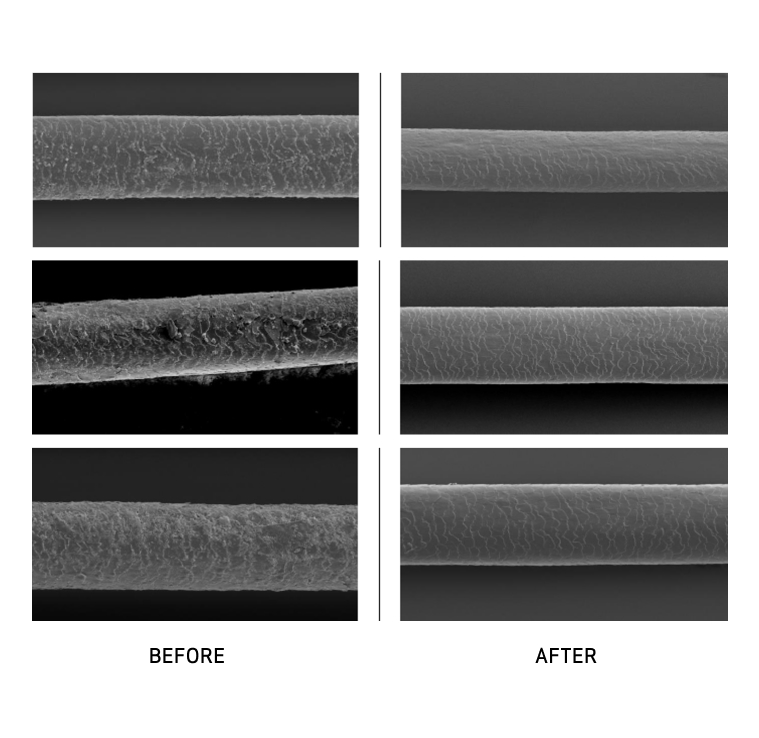
In healthy hair, the cuticle scales remain compact and aligned, forming a uniform surface. This organization allows light to reflect evenly, providing shine, softness, and easier manageability.
However, over time and with repeated exposure to environmental and chemical aggressors, the cuticle progressively loses cohesion. The scales become less uniform, friction between fibers increases, and the thin lipid layer covering the surface deteriorates.
This layer is rich in 18-methyleicosanoic acid (18-MEA), an essential lipid that helps maintain hydrophobicity, softness, and the hair’s natural ability to repel moisture.
As a result, the hair fiber loses part of its surface protection, accumulates more static electricity, responds less uniformly to environmental humidity, and its ability to remain aligned diminishes.
The visible result of all these changes is frizz.
From a scientific standpoint, frizz can be considered a cosmetic marker of hair fiber aging; it is a manifestation that the fiber surface has lost part of its structural organization and integrity.
Why does humidity make hair frizzy?
One of the most common questions is why humidity makes hair frizzy and why frizz appears more intensely on certain days or in certain climates.
Humidity, however, does not create frizz, just as light does not create a wrinkle on the skin. What it does is reveal a structural alteration that already existed on the surface of the hair fiber.
The explanation lies in a fundamental property of the hair fiber: its hygroscopic nature.
Keratin, the main structural protein of the hair fiber, has the ability to continuously absorb and release water depending on environmental conditions. This behavior is part of the fiber’s natural balance and allows it to adapt to changes in ambient humidity.
However, the way hair responds to moisture largely depends on the condition of the cuticle.
In healthy hair, the surface remains protected by a thin lipid layer rich in 18-MEA, which gives the fiber its hydrophobic properties and helps regulate water exchange with the environment. This barrier allows moisture absorption to occur in a relatively uniform way.
With fiber aging and continuous exposure to UV radiation, heat, chemical treatments, or mechanical friction, this protective layer progressively deteriorates.
As a result, the cuticle loses cohesion, porosity increases, and the hair becomes more susceptible to absorbing moisture unevenly.
When environmental humidity rises, water molecules penetrate the fiber and establish new hydrogen bonds with keratin. The fiber undergoes slight swelling and a temporary reorganization of its molecular structure.
This is when frizz appears.
In other words, humidity does not cause the “hair wrinkle”; it simply makes the aging of the hair surface more visible.
Why does summer make frizz worse?
Many people notice that their hair becomes frizzier during the summer, but humidity is not the only factor responsible.
During this season, several factors converge to accelerate hair fiber aging and promote the appearance of frizz:
- Ultraviolet radiation:promotes photo-oxidation of the proteins and lipids within the hair fiber.
- Saltwater and pool chlorine: alter the cuticle surface and accelerate the loss of the protective lipid layer. .
- High temperatures: increase fiber dehydration.
- Wind exposure:increases mechanical friction and progressive cuticle wear.
Each of these aggressors leaves a small mark on the hair’s surface.
Individually, they may seem insignificant, but their effect is cumulative.
That is why summer does not create frizz. What it does is accelerate the aging mechanisms that contribute to the appearance of our “hair wrinkle,” which is why protecting the hair fiber from these external aggressions is so important.
How do anti-frizz treatments work?
Anti-frizz treatments do not permanently alter the hair’s structure. .
Their function is to optimize the surface behavior of the fiber through conditioning ingredients and film-forming polymers that create a uniform cosmetic layer over the cuticle.
This coating helps smooth surface irregularities, reduce friction between fibers, minimize static electricity build-up, and limit uncontrolled moisture absorption.
Rather than “taming” frizz, these treatments help preserve a more uniform hair surface, promoting hair that looks visibly smoother, shinier, and more disciplined.
From science to formulation
Understanding the mechanisms that promote frizz makes it possible to develop formulations designed to preserve the integrity of the hair fiber.
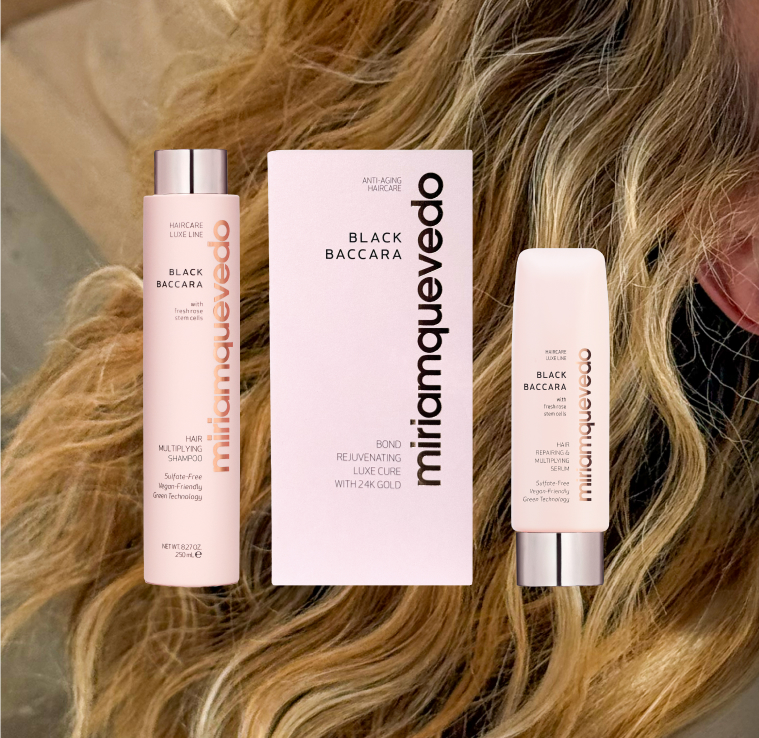
This approach inspires the Black Baccara, which in instrumental testing demonstrated up to 3.5 times less frizz and electrostatic effect compared to untreated hair, with results maintained for up to 8 hours.*
If frizz is the “hair wrinkle,” the future of haircare lies in understanding and preserving the biology of the hair fiber through science.
*Results obtained through an instrumental study conducted by an independent laboratory on 5 hair tresses subjected to chemical and thermal damage. Results correspond to the combined use of the Black Baccara Hair Multiplying Shampoo, Black Baccara Bond Rejuvenating Luxe Cure (Phase 1 + Phase 2), and Black Baccara Hair Repairing & Multiplying Serum. Results may vary depending on the initial condition of the hair and conditions of use.